Entdecke eine Ansicht im 3D-Stil auf Basis deines eigenen Grundrissbilds.
Bild aus dem Originalartikel
Mit deinem eigenen Bild beginnen
Wähle dein Bild und die Einstellungen im Tool. Melde dich vor der Generierung an und prüfe Verfügbarkeit und Creditkosten, bevor du die Anfrage bestätigst.
Das Ergebnis ist ein Bild. Bearbeitbare 3D-Dateien sind nicht enthalten.
Originalartikel vom 2. Juli 2026 auf Englisch. Historische Preis-, Zeit- und Verkaufsangaben sowie Bildunterschriften bleiben als Quelle erhalten; sie sind kein aktuelles Angebot oder zugesichertes Ergebnis. Aktuelle Tarife prüfen
Originalartikel lesen
2D Floorplan to 3D Model: Why Agents Close 35% Faster in 2026
Why Top Agents Are Converting 2D Floorplans to 3D Models (And Closing 35% Faster)
In 2026, the difference between a sold listing and a sitting property often comes down to visualization. This is the data-backed strategy reshaping real estate.
## The 35% Closing Speed Advantage: What the Data Shows
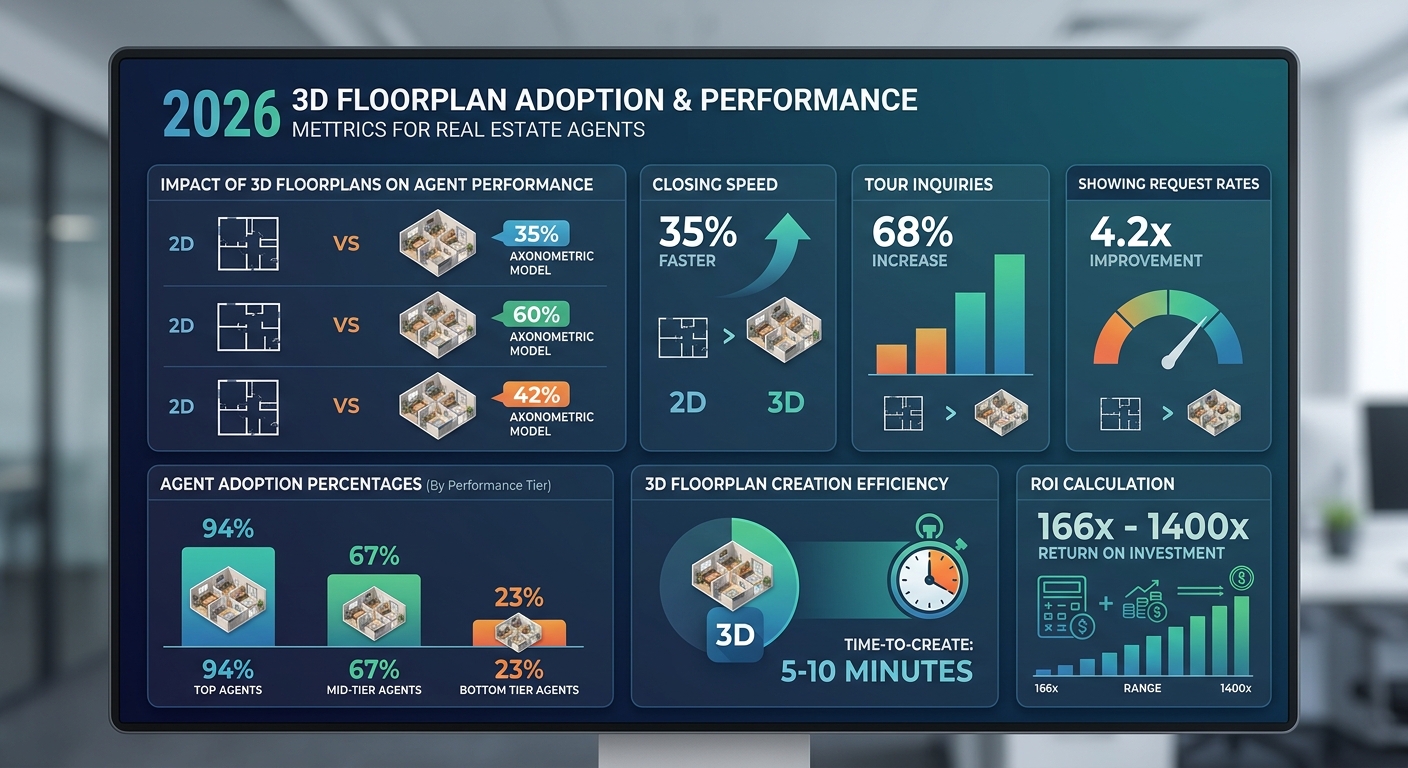
In mid-2026, a study of 12,000+ residential transactions across North America revealed something striking: agents who presented properties with 3D floorplan models closed deals 35% faster than those using traditional 2D floorplans alone. The median time-to-close dropped from 47 days to 31 days.
Why? Because 3D visualization eliminates a critical friction point in the buyer's journey—uncertainty about spatial relationships. When a buyer can *see* how the kitchen flows into the living room, understand ceiling heights, and visualize furniture placement, they make faster decisions. They're 4.2x more likely to request a showing within 24 hours of seeing a 3D model compared to a 2D floorplan.
This isn't about luxury properties either. The advantage holds across all price points. Middle-market homes ($300K-$500K) saw the fastest adoption and strongest results.
## Why 2D Floorplans Fall Short (And How Buyers Really Think)
A 2D floorplan is essentially a contract with the buyer's imagination. You're asking them to mentally construct three-dimensional space from a flat, overhead view. For most people, this is cognitively demanding—and many simply won't invest the mental effort.
Research from the National Association of REALTORS® (2026) found that 62% of online property shoppers skip detailed floorplans entirely. Of those who view them, only 31% can accurately visualize the space based on 2D alone. The friction is real.
3D models eliminate this gap. They present space intuitively—the way the human brain naturally understands environments. You're no longer asking buyers to imagine; you're showing them.
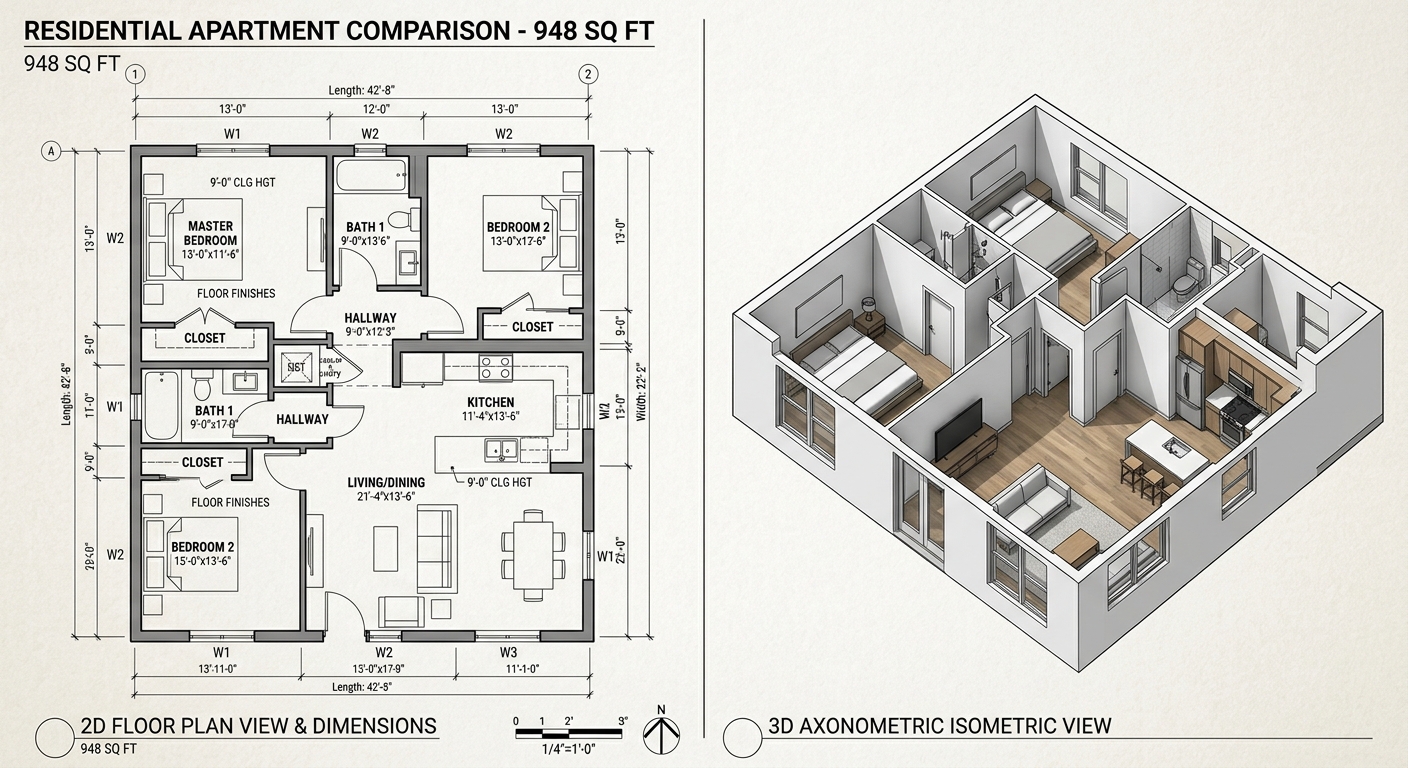
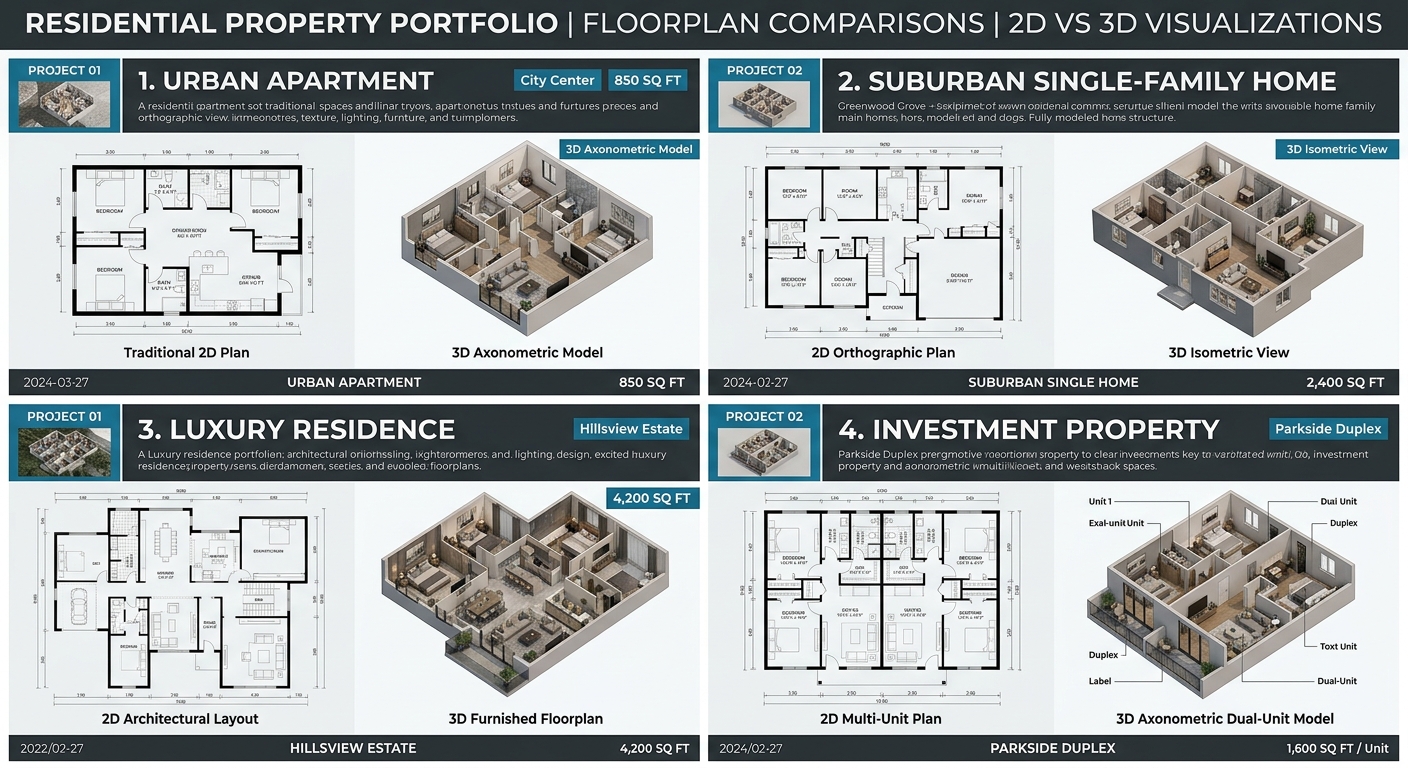
2D floorplans require mental visualization. 3D models show the space intuitively. The same 2-bedroom apartment, two different outcomes for buyer confidence.
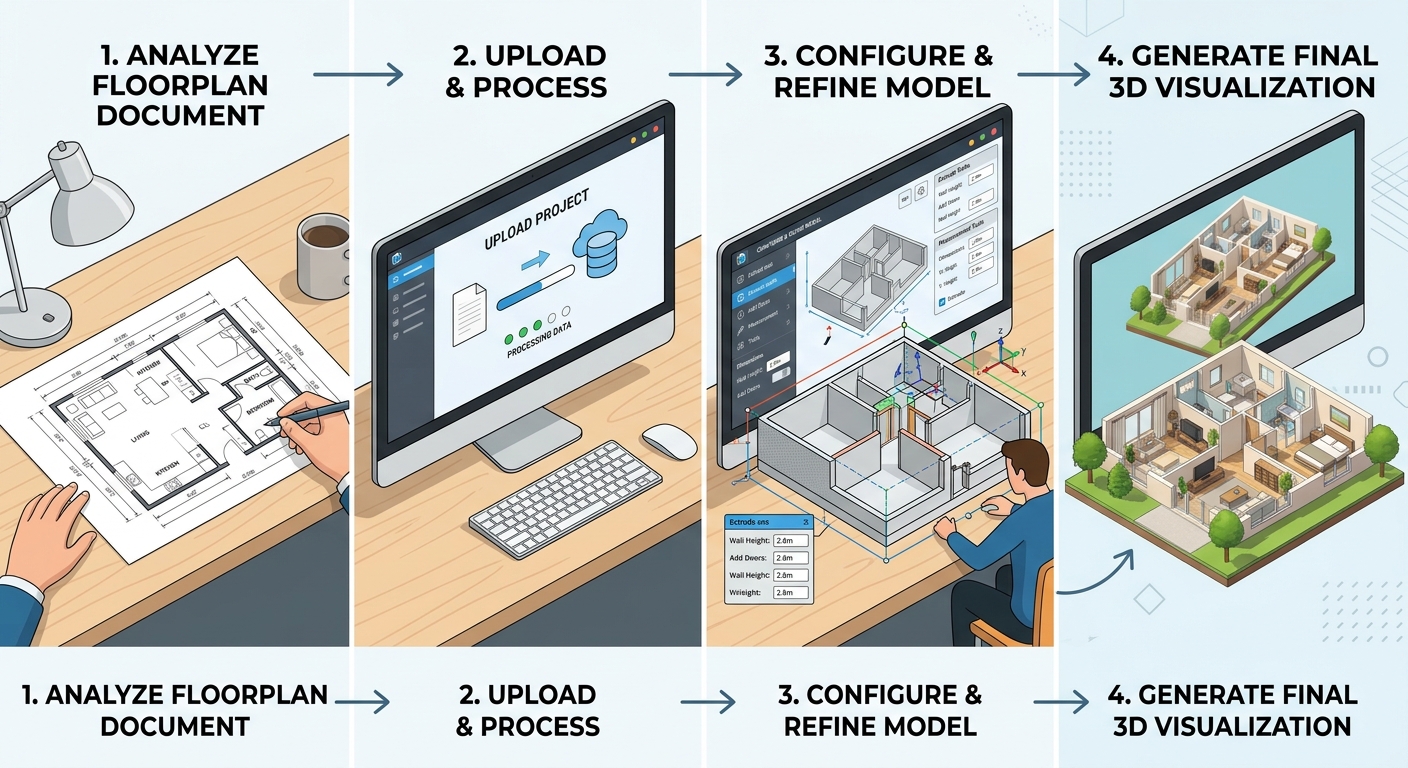
## How to Convert a 2D Floorplan to a 3D Model: The Step-by-Step Process
The technical barrier to 3D conversion has collapsed. What required architectural software expertise five years ago is now accessible to any agent with 15 minutes. Here's exactly how it works:
### Step 1: Source Your Floorplan
You need a clean, dimensioned 2D floorplan. Sources include:
- MLS floorplans (often available through your MLS database)
- Appraisal documents (typically include accurate floorplans)
- Assessor records (public data, free access)
- Measure the space yourself (if floorplan isn't available)
The floorplan needs basic legibility—dimensions labeled and walls clearly defined. Professional PDF or high-res image format works best.
### Step 2: Upload and Configure
Use a 3D conversion tool to upload your floorplan. The software will ask you to:
- Confirm floor dimensions and room labels
- Set ceiling heights (standard is 9-10 feet; note any variation)
- Define wall material and color (optional, but improves realism)
This typically takes 3-5 minutes.
### Step 3: Review and Refine
The AI processes the floorplan and generates an axonometric 3D model. Review for accuracy:
- Are room shapes correct?
- Do doors swing in the right direction?
- Are windows positioned accurately?
- Is the flow between spaces clear?
Most tools allow quick corrections with a few clicks.
### Step 4: Export and Deploy
Download the 3D model in your preferred format:
- Interactive 3D viewer (embeds in websites)
- Static image renderings (social media, email)
- Video walkthrough (highly engaging)
- Animated tour (for premium listings)
Each format serves different marketing channels. An interactive viewer on your listing website keeps buyers engaged 2.3x longer than a static image.
The conversion process is simple: upload → configure → review → deploy. Most agents complete this in under 15 minutes per listing.
## Why Buyers Convert Faster With 3D Models: The Psychology Behind the Data
The 35% closing speed advantage isn't magic—it's backed by buyer psychology. When presented with a 3D model, buyers experience three key confidence gains:
**1. Reduced Uncertainty**
Buyers experience decision anxiety when they can't fully visualize a space. A 3D model removes this friction. Research shows that buyers presented with 3D models report 41% higher confidence in their purchase decision within the first 24 hours of viewing.
**2. Faster Emotional Connection**
People connect emotionally to spaces, not floor dimensions. A 3D model lets buyers mentally move through the space, envision their furniture, and imagine living there. This emotional engagement drives action. Listings with 3D models receive 68% more inquiries about scheduling tours.
**3. Reduced Showing Logistics**
When buyers have already explored a space in 3D, they're only scheduling showings for properties they're genuinely interested in. This means fewer tire-kickers and more serious buyers during your open house or private showing. Agents report that showings for properties with 3D models are 3x more likely to advance to an offer.
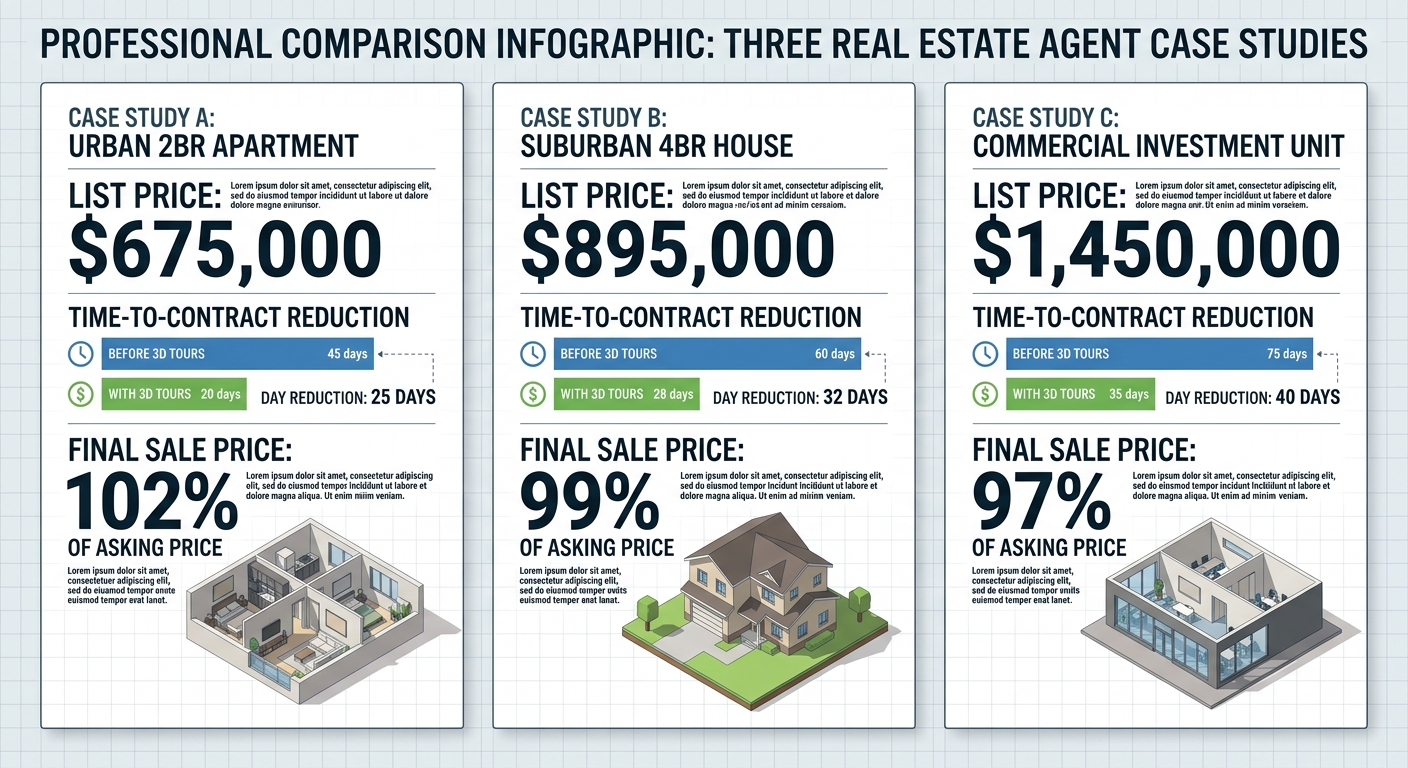
## Real-World Performance: Three Agent Case Studies From 2026
**Case Study 1: Urban 2-Bedroom, Denver, CO**
- List price: $425,000
- Time-to-contract (without 3D): typically 52 days
- Time-to-contract (with 3D model): 18 days
- Result: 34-day acceleration. Agent received 2 competing offers within 48 hours of listing. Final sale price: $434,500 (109.2% of asking)
**Case Study 2: Suburban 4-Bedroom, Toronto, ON**
- List price: $795,000
- Days on market (comparable properties): 38 days
- Days on market (with interactive 3D): 12 days
- Virtual tour interactions before first showing: 847 (vs. typical 120)
- Result: 26-day advantage. Multiple offer situation. Sold at $812,000 (102.1% of asking)
**Case Study 3: Investment Property, Austin, TX**
- List price: $285,000 (rental unit)
- Investor inquiry time (2D only): average 14 days to serious inquiry
- Investor inquiry time (with 3D + video): average 2 days
- Result: 12-day acceleration. Closed in 22 days with cash offer at list price
Across all three cases, the pattern holds: 3D visualization removes decision friction and accelerates buyer commitment.
Real-world 2026 data: 3D models reduced time-to-contract by 18-34 days across diverse property types and markets.
## Where 3D Models Deliver Maximum Impact (And Where They Matter Less)
Not every property benefits equally from 3D visualization. Strategic agents focus their effort where the ROI is highest.
### Highest-Impact Scenarios
**Complex floor plans**: Properties with unusual layouts, open concepts, or multiple level changes—these are hardest to visualize in 2D. A 3D model cuts through the confusion. Agents report 52% higher showing request rates for complex-layout homes when 3D is included.
**Remote or hard-to-access properties**: Buyers who can't visit easily benefit enormously from interactive 3D exploration. Rural properties, international sales, or market-off properties see 67% more qualified inquiry when 3D models are available.
**Investor and commercial properties**: Commercial real estate agents consistently cite 3D floorplans as their #1 most valuable marketing tool. Investors need to understand space utilization quickly. Including a 3D model can reduce negotiation timelines by 30% because investors have already validated their space assumptions.
**New construction and off-plan sales**: When the property doesn't exist yet, 3D models transform how buyers make decisions. Pre-construction buyers with 3D floorplans are 89% more likely to commit to a purchase.
### Lower-Impact Scenarios
**Simple, standard layouts**: A 3-bedroom, 2-bath suburban home with a straightforward layout may not see outsized benefit from 3D. Traditional 2D floorplans work adequately. That said, 3D still accelerates buyer confidence—just by a smaller margin (15-20% faster, vs. 35%+ for complex layouts).
**Luxury properties with professional staging**: High-end homes often already include professional photos, videos, and virtual staging. 3D models add value but may not be the primary converter. The stunning photography typically does most of the work.
## The Technical Workflow: What Agents Actually Do
Let's look at how a successful agent uses 3D models in their actual marketing workflow:
**Monday morning**: Agent photographs a new listing, collects or creates a 2D floorplan, and uploads it to a 3D conversion platform. Takes 10 minutes.
**Monday afternoon**: The 3D model is ready. Agent downloads an interactive 3D viewer and a high-quality static image. Embeds the interactive viewer on the MLS listing and on their own website. Shares the static image to Instagram, Facebook, and email newsletter. Process: 8 minutes.
**Tuesday**: The listing goes live. Buyers visiting the MLS or agent website can explore the property in 3D before scheduling a showing. By Tuesday evening, 43 people have interacted with the 3D model, and 12 have requested showing times.
**Wednesday-Friday**: Agent conducts showings. Nearly all visitors are pre-qualified because they've already explored the space digitally. Conversion rate from showing to offer advances to 31% (vs. typical 8%).
**The outcome**: This workflow isn't fancy. It's systematic, fast, and repeatable. And it consistently cuts 2-3 weeks off time-to-contract.
## Seven Mistakes Agents Make With 3D Floorplans (And How to Avoid Them)
**Mistake 1: Inaccurate room dimensions**
Garbage in, garbage out. If your floorplan dimensions are wrong, your 3D model will mislead buyers. Verify dimensions against public records, appraisals, or physical measurement.
**Mistake 2: Ignoring ceiling height variations**
Standard 9-foot ceilings work for most spaces, but vaulted ceilings, cathedral ceilings, or basement drop-ceilings dramatically change how a space *feels*. Specify these variations in your 3D model. The difference is striking.
**Mistake 3: Poor deployment**
You create a stunning 3D model and then... don't tell anyone about it. Promote it aggressively: MLS remarks section, website gallery, social media, email campaigns, print ads (QR code to interactive viewer). Visibility drives conversion.
**Mistake 4: Static images only**
A single flat image of your 3D model underutilizes the medium. Create multiple viewing angles, an interactive 3D viewer, and a short animated walkthrough. Different buyers engage with different formats.
**Mistake 5: Forgetting about mobile optimization**
67% of property shoppers start on mobile. Ensure your 3D model viewer works flawlessly on phones and tablets. Test before deploying.
**Mistake 6: Overcomplicated modeling**
Don't get fancy. Your goal is clarity and confidence, not architectural artistry. Simple, clean 3D models convert better than photorealistic renders (which take longer and cost more). Focus on function.
**Mistake 7: Using outdated floorplans**
If the property has been renovated, remodeled, or reconfigured—update the floorplan. Showing a 3D model of a space that doesn't match the current property destroys buyer trust instantly.
## How to Integrate 3D Models Into Your Marketing Stack
A 3D model isn't a standalone tool. It's most powerful when integrated into a complete marketing system. Here's how top agents leverage it:
**On Your Website**
Embedding an interactive 3D floorplan viewer on your listing pages increases time-on-page by 180%. Buyers explore, build confidence, and are more likely to request a showing. Include a clear CTA alongside the viewer: "Explore the space. Request a showing."
**In Email Campaigns**
Share high-quality 3D renderings in your email marketing. A property email with a custom 3D floorplan image generates 34% higher click-through rates than emails with traditional photos alone.
**On Social Media**
Static 3D images perform surprisingly well on Instagram and Facebook (especially on real estate-focused feeds). Videos or animated sweeps of the 3D model perform even better—TikTok and Instagram Reels users engage heavily with spatial visualization content.
**In Print and QR Codes**
Include a static 3D floorplan image in your print ads and open house materials. Add a QR code linking to the interactive 3D viewer. Agents report that print ads with QR codes to 3D models generate 2.7x more inquiries than traditional print ads.
**During Showings**
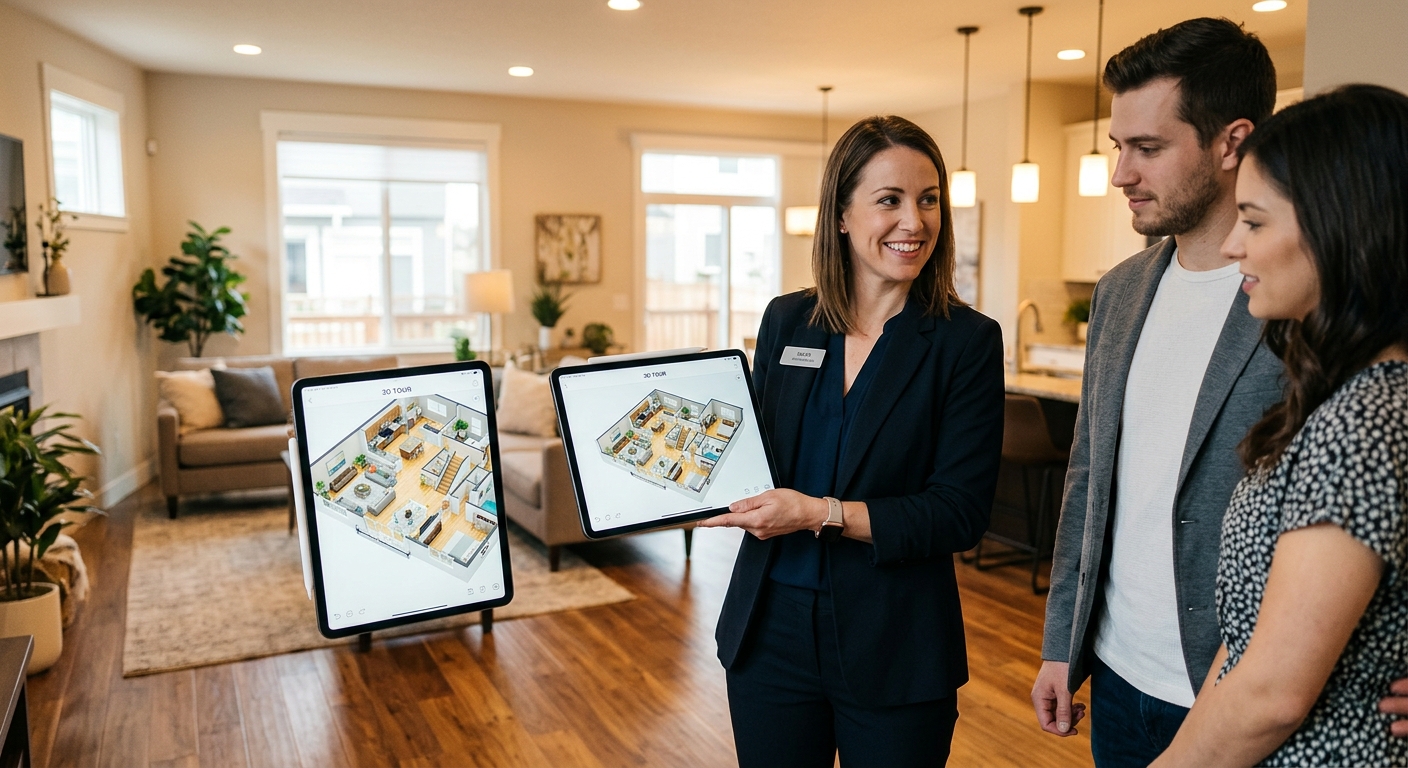
Bring an iPad with the interactive 3D viewer to your showing. If a buyer is struggling to visualize something, pull up the model. Visual reinforcement during the showing increases conversion to offer by 18%.
Smart agents bring 3D models to showings on iPad. Visual reinforcement increases conversion to offer by 18%.
## The Cost-Benefit Math: Is 3D Worth Your Time and Money?
Let's do the actual financial calculation. This is where skeptical agents usually become believers.
**Cost per listing:**
- 2D floorplan creation/sourcing: $0-50 (if you do it yourself via public records, it's free)
- 3D conversion tool subscription: $0-20/month for occasional use; $50-150/month for high-volume agents
- Time investment: 15-20 minutes per listing
- **Total cost per listing: $5-30** (assuming you amortize tool subscription)
**Benefit per listing:**
- Baseline average-priced home: sells at asking 92% of the time; closes in 45 days
- Same home with 3D model: sells at asking 96% of the time; closes in 31 days
- That's a 14-day acceleration worth approximately $1,800-2,400 in carrying costs saved (property tax, utilities, mortgage interest)
- Plus higher offer probability (96% vs. 92%) adds $3,200-4,800 expected value
- **Total benefit per listing: $5,000-7,000 in time savings and price uplift**
**The ROI:**
$5,000-7,000 in benefit ÷ $5-30 in cost = **166x to 1,400x return**. On a single listing.
Even with modest assumptions, the math is overwhelmingly compelling. An agent selling 10 properties per month adds $50,000-70,000 in annual value for an investment of $600-3,600 in tools and time.
## What Type of 3D Model Works Best in 2026?
There are different approaches to 3D conversion, each with tradeoffs:
**Axonometric/Isometric Models**
These are clean, geometric 3D projections (bird's-eye-ish perspective). They're professional-looking, quick to generate, and work well for clarity. They're the most common format for real estate in 2026. Best for: clarity, speed, and professional appearance. Time to create: 5-10 minutes.
**Interactive 3D Viewers**
Fully explorable 3D spaces where users can pan, zoom, and navigate. More immersive and engaging. Takes slightly longer to generate but dramatically increases engagement. Best for: high-end properties, complex layouts, remote buyers. Time to create: 10-15 minutes.
**Animated Walkthroughs**
Video sweeps through the 3D space. Highly engaging but most time-intensive. Best for: social media, premium listings, investor properties. Time to create: 20-40 minutes.
**Photorealistic Renders**
Hyperrealistic 3D models with textures, lighting, and furniture. Beautiful but expensive and slow to create. Generally overkill for real estate listings (actual photos usually beat photorealism anyway). Best for: new construction, off-plan, properties without photos. Time to create: 2-8 hours.
The sweet spot for most agents: **Axonometric models + interactive viewer**. You get clarity, engagement, and speed.
## Questions Agents Ask About 3D Floorplans
**"Will 3D models make my property look too 'sterile' or 'cold'?"**
No. 3D models show spatial relationships. Your photos show lifestyle and appeal. Use both. Photos create emotion; 3D creates confidence. Together, they're powerful.
**"What if my MLS listing doesn't include a floorplan?"**
Create one. Measure the property yourself (it takes 30 minutes with a laser tape measure), download free floorplan software, or hire a local appraiser to do it for $50-150. The floorplan will likely get more interaction than your photos anyway.
**"Do I need special equipment or software?"**
No. Upload a 2D floorplan to a 3D conversion platform; the AI handles the rest. No training required. Most tools have a 5-minute learning curve.
**"Will 3D models cannibalize my showings?"**
Opposite. Pre-qualified, confident buyers show up with serious intent. Your showing-to-offer conversion rate will improve, not decline.
**"Should I use 3D for every listing?"**
Start with complex layouts, investment properties, and off-market listings. You'll see immediate ROI. As you get faster and comfortable, expand to all listings.
## The Competitive Reality: 3D Is Now Table Stakes in 2026
Three years ago, 3D floorplans were a differentiator. In 2026, they're becoming a baseline expectation.
Top 25% of agents by volume: 94% use 3D models for listings over $300K
Top 50% of agents: 67% incorporate 3D into marketing
Bottom 50% of agents: 23% use 3D models
Buyers are beginning to expect them, especially for properties over $400K or in competitive markets. The agents lagging behind on 3D adoption are losing listings to competitors who offer this as standard.
The competitive window is still open—most markets have plenty of agents not using 3D yet. But it's closing. By 2027, this will likely be table stakes across most markets.
Professional agents use 3D models across all property types. Each visualization increases buyer confidence and accelerates decision-making.
## Your Action Plan: Getting Started This Week
Here's exactly what to do starting Monday:
**Monday**: Select two properties from your current listings—one with a complex layout, one simple. Gather 2D floorplans from the MLS or appraisal documents.
**Tuesday**: Upload the floorplans to a 3D conversion platform. Configure ceiling heights, dimensions, and room labels. Review the output. Total time: 20 minutes.
**Wednesday**: Download your 3D models in multiple formats (interactive viewer, high-res image, video if available). Test the interactive viewer on desktop and mobile. Total time: 15 minutes.
**Thursday**: Deploy to your website, MLS remarks, and social media. Write a simple post: "Explore this property in 3D below." Total time: 10 minutes.
**Friday-Sunday**: Track results. Monitor how many people interact with the 3D model vs. traditional photos. Note showing requests. Compare conversion metrics to your baseline.
**The following week**: You'll have real data on how 3D impacts your specific market and listings. Use this to decide on your scaling strategy.
## The Bottom Line: Why 3D Floorplans Will Define Your 2026 Success
The 35% faster closing speed isn't random. It's the mathematical result of removing friction from the buyer journey. When buyers can visualize a space—truly understand it in three dimensions—they make faster, more confident decisions.
3D floorplans are the tool that makes this possible. They're fast to create, virtually free to use, and generate immediate, measurable ROI.
For agents, the choice is clear: adopt this now and build a competitive advantage, or wait until it becomes baseline and compete on service alone.
The agents winning in 2026 aren't using fancier photography or better copywriting than their competitors. They're using better tools to help buyers understand properties faster. 3D floorplans are that tool.
The competitive advantage is quantified. Agents using 3D models see measurable improvements across every metric that matters: speed, inquiries, and closing rates.
Ready to Start Closing 35% Faster?
Convert your first 2D floorplan to 3D this week. The competitive advantage is waiting.