Inherited a House? 7 Steps to Maximize Property Value Before Selling
# The Hidden Opportunity in Inherited Properties Inheriting a house can feel overwhelming. You're managing emotions, legal paperwork, and suddenly responsible for a major asset worth hundreds of thou
Inherited a House? 7 Steps to Maximize Property Value Before Selling
Turn your inherited property into maximum profit with proven strategies that increase sale prices by 15-25%
# The Hidden Opportunity in Inherited Properties
Inheriting a house can feel overwhelming. You're managing emotions, legal paperwork, and suddenly responsible for a major asset worth hundreds of thousands of dollars. According to the National Association of Realtors, 68% of inherited properties are sold within the first 18 months, yet most heirs leave 15-25% of potential value on the table by rushing the sale.
In 2026's competitive real estate market, where the median home price sits at $412,000, that oversight can cost you $60,000-$100,000 or more. The difference between a hasty sale and a strategic one often comes down to following a systematic approach to property preparation.
This comprehensive guide walks you through seven critical steps that professional house flippers and real estate investors use to maximize returns. Whether you've inherited a pristine property or a fixer-upper, these strategies will help you make informed decisions that significantly impact your final sale price.
## Understanding Your Starting Point: The Initial Assessment
Before making any decisions, you need a clear picture of what you're working with. The first 30 days after inheriting property should focus on thorough evaluation, not hasty action.
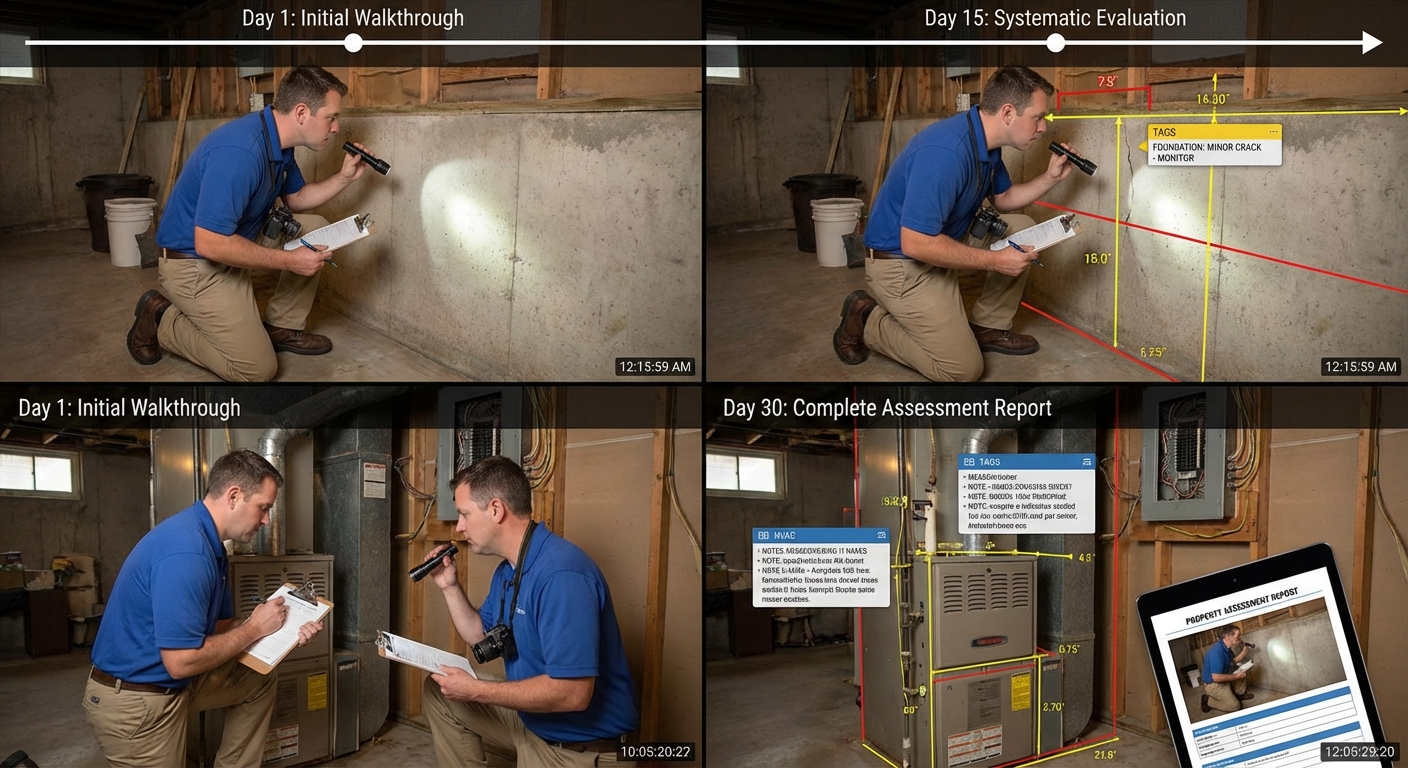
### Step 1: Conduct a Professional Property Inspection
Invest $400-$600 in a comprehensive home inspection before doing anything else. This upfront cost provides invaluable insights that shape your entire strategy.
What a professional inspection reveals:
- **Structural issues**: Foundation cracks, roof damage, water intrusion problems that affect habitability
- **System functionality**: HVAC, plumbing, electrical systems that may need immediate attention
- **Safety hazards**: Mold, asbestos, lead paint common in pre-1980 homes
- **Hidden repairs**: Issues not visible during casual walkthroughs
A 2026 study by HomeAdvisor found that sellers who addressed major inspection items before listing received offers averaging 8.3% higher than those who disclosed problems without fixing them. The inspection report becomes your roadmap for strategic improvements.
**Pro tip**: Request itemized cost estimates for each issue identified. This helps you prioritize repairs based on ROI and determine whether selling as-is to an investor might be more profitable for severely damaged properties.
### Step 2: Get a Pre-Sale Appraisal and Comparative Market Analysis
Understanding your property's current and potential value is crucial for making smart investment decisions about improvements.
Order both:
1. **Professional appraisal** ($350-$500): Provides objective current value based on condition
2. **Realtor's CMA** (free): Shows comparable sales and reveals what buyers are paying in your specific neighborhood
Compare recently sold properties in three categories:
- **As-is condition**: Properties sold with minimal preparation
- **Lightly updated**: Homes with cosmetic improvements
- **Fully renovated**: Properties with major updates
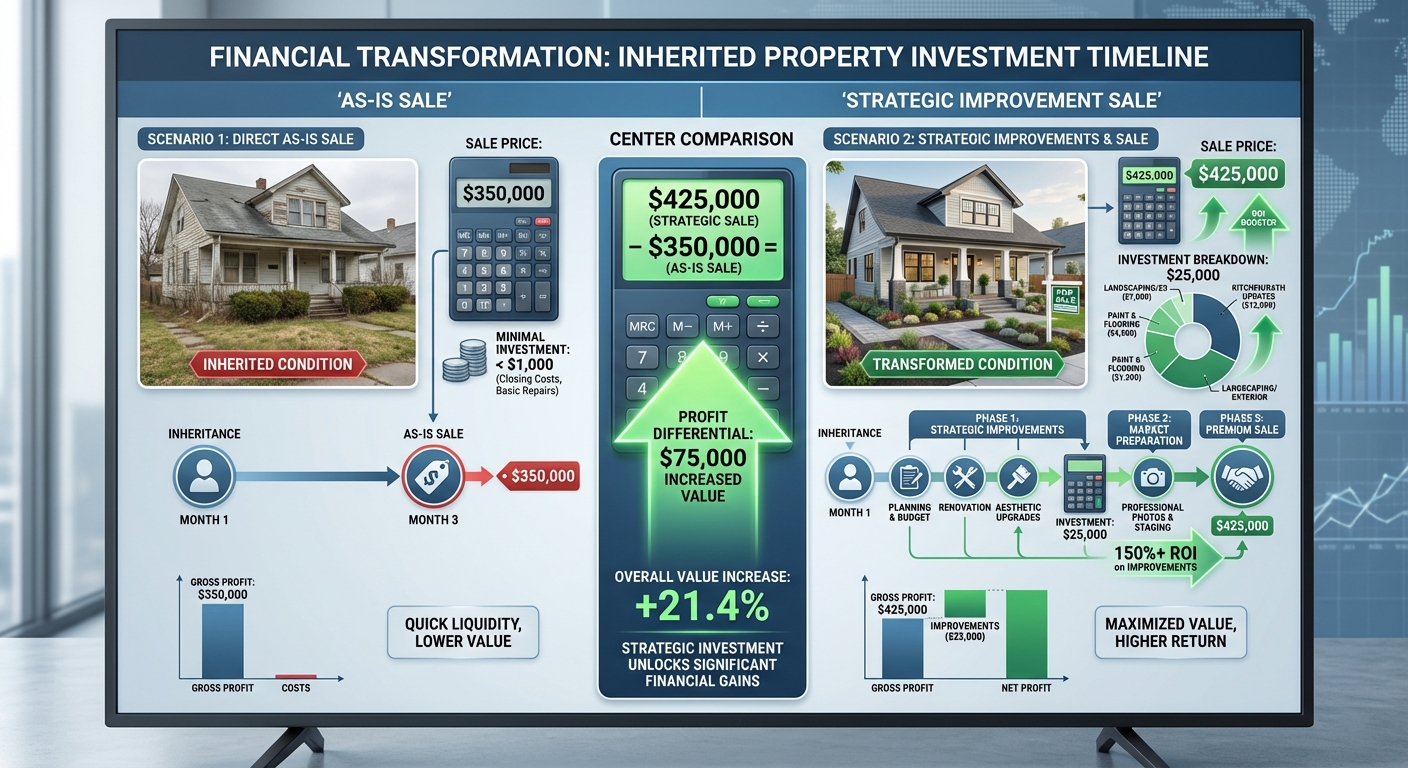
The price gaps between these categories reveal your potential profit margin from improvements. If fully updated homes sell for $50,000 more than as-is properties, and updates cost $25,000, you're looking at $25,000 net gain—a 100% ROI on improvements.
A thorough 30-day assessment period reveals hidden issues and opportunities before making any improvements
## Strategic Improvements: Where to Invest Your Money
### Step 3: Prioritize High-Impact, Low-Cost Improvements
Not all improvements deliver equal returns. Focus your budget on changes that dramatically affect buyer perception without breaking the bank.
**The 80/20 rule for inherited properties**: 80% of your value increase comes from 20% of possible improvements. Here's where those high-impact areas are:
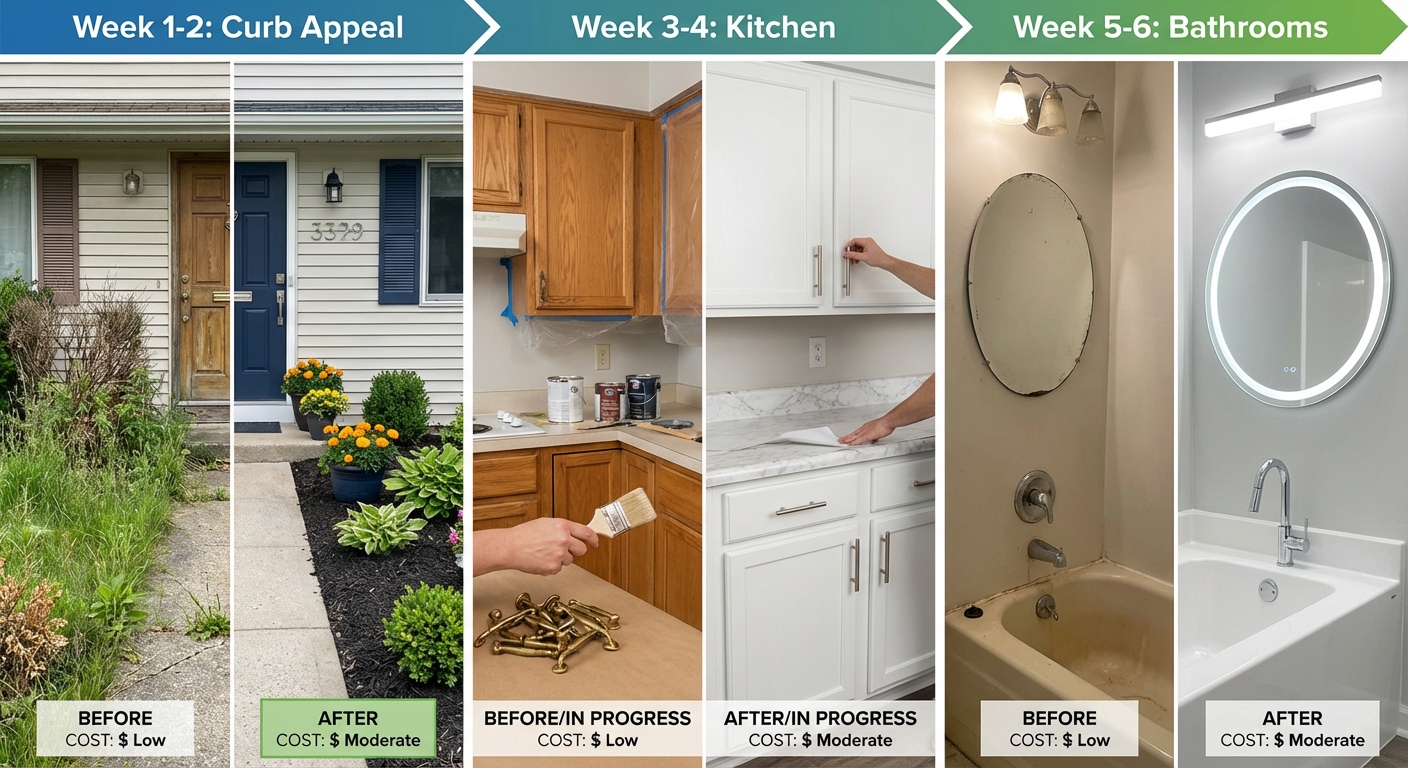
#### Curb Appeal (ROI: 100-200%)
Buyers form opinions within 7 seconds of seeing your property. Invest here first:
- **Landscaping refresh** ($500-$2,000): Trim overgrown shrubs, add fresh mulch, plant colorful annuals, edge walkways
- **Exterior paint touch-ups** ($300-$1,500): Focus on front door, shutters, and trim rather than entire house
- **Pressure washing** ($200-$500): Clean siding, driveway, walkways, and deck
- **Lighting upgrades** ($150-$600): Replace outdated fixtures, add pathway lighting
A 2026 NAR study found that homes with excellent curb appeal sold 20% faster and received offers averaging 7% higher than similar properties with poor exterior presentation.
#### Kitchen Updates (ROI: 70-120%)
You don't need a full renovation to make kitchens shine:
- **Cabinet refresh** ($500-$3,000): Professional painting or refacing beats $25,000 replacement
- **Hardware replacement** ($100-$400): New cabinet pulls and drawer handles modernize instantly
- **Countertop solutions** ($800-$4,000): Butcher block or laminate overlays cost fraction of granite replacement
- **Lighting upgrade** ($200-$800): Under-cabinet LED strips and modern fixtures transform atmosphere
- **Appliance consideration**: If appliances are pre-2015, stainless steel replacements ($2,000-$4,000) often pay for themselves
#### Bathroom Improvements (ROI: 65-100%)
Bathrooms heavily influence buyer decisions:
- **Deep cleaning and re-caulking** ($200-$500): Fresh grout and caulk suggest well-maintained home
- **Fixture updates** ($300-$1,200): New faucets, showerheads, towel bars for modern look
- **Vanity refresh** ($400-$2,000): Paint existing cabinets, add new countertop and sink
- **Lighting and mirrors** ($200-$800): Proper lighting eliminates dungeon-like older bathrooms
**Cost-benefit analysis example**: A $5,000 bathroom refresh typically adds $6,500-$8,000 in perceived value, while a $20,000 full remodel might only add $15,000-$18,000 in actual sale price increase.
Strategic improvements in three key areas deliver maximum ROI without requiring full renovations
### Step 4: Address Major Repairs Strategically
Some repairs you must make; others depend on your market and timeline.
#### Mandatory repairs (always fix these):
- **Safety issues**: Electrical hazards, structural damage, mold, asbestos
- **Functional systems**: Non-working HVAC, plumbing leaks, roof damage causing water intrusion
- **Code violations**: Unpermitted work, illegal additions, safety code violations
These issues kill deals during buyer inspections and cost you negotiating power. Fix them proactively.
#### Strategic repair decisions:
**Roof replacement dilemma**: A roof with 3-5 years of life remaining presents a difficult decision. Full replacement costs $8,000-$15,000 but may only add $5,000-$8,000 to sale price. Options:
- **Seller's market**: Disclose age, offer credit, let buyer handle replacement
- **Buyer's market**: Replace it to avoid deal-killers and price reductions
- **Middle ground**: Get quotes, offer specific credit amount based on actual costs
**HVAC system considerations**: Systems older than 15 years will concern buyers, but $6,000-$12,000 replacement may not return full value. Consider:
- Home warranty inclusion ($400-$600 annual cost) that covers system
- Maintenance records proving system functionality
- Price adjustment rather than replacement for working but old systems
**Foundation and structural**: Never skip these repairs. Buyers can't get mortgages on homes with structural issues, and cash investors will lowball offers by 2-3x actual repair costs.
## Creating Buyer Appeal: Presentation Matters
### Step 5: Deep Clean and Declutter Every Space
This step costs more time than money but delivers remarkable results. Properties that feel clean and spacious sell for 3-5% more than comparable cluttered homes.
#### The systematic approach:
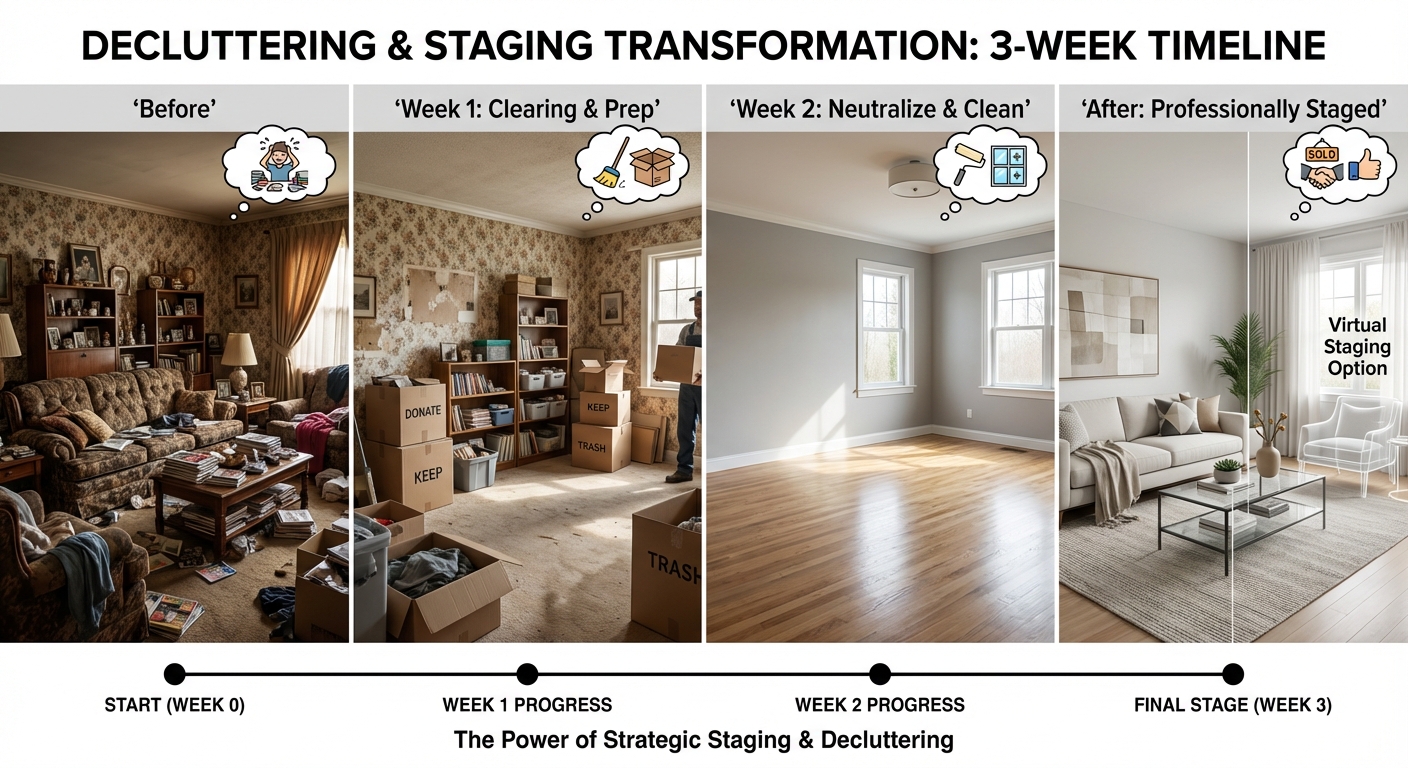
**Week 1 - Remove everything non-essential**:
- Rent dumpster or POD ($200-$500)
- Remove 80% of furniture, personal items, collectibles
- Clear countertops completely (kitchen/bathroom should be bare)
- Empty closets to 25% capacity to show storage space
**Week 2 - Deep clean every surface**:
- Hire professional cleaners ($300-$600 for deep clean)
- Clean inside cabinets, drawers, closets
- Wash windows inside and out
- Clean/replace air filters, dust vents and baseboards
- Steam clean or replace dated carpeting
**Week 3 - Make it neutral**:
- Repaint bold colors in neutral warm grays or soft whites ($1,500-$4,000 for whole house)
- Remove wallpaper (especially busy patterns)
- Replace busy tile or countertop if extremely dated
**The minimalism test**: Walk through each room. If you notice décor or furniture before noticing the space itself, remove more items. Buyers should visualize their belongings, not navigate around yours.
### Step 6: Stage Strategically for Maximum Impact
Empty houses sell for 6-10% less than furnished properties and sit on market 30-40% longer. But full traditional staging costs $2,000-$6,000 monthly.
#### Modern staging solutions:
**For occupied showings**:
- Focus on main living areas: living room, master bedroom, kitchen
- Rent neutral furniture if inherited pieces are dated ($500-$1,500/month)
- Use universal appeal: grays, whites, natural wood tones
- Add strategic touches: fresh flowers, bowl of lemons, luxury towels in bathrooms
**For photography and virtual tours**:
Professional listing photos determine whether buyers schedule showings. In 2026, 97% of buyers begin their search online, and homes with high-quality photos receive 118% more online views.
Virtual staging technology has transformed this space. AI-powered tools can digitally furnish empty rooms for listing photos at fraction of traditional staging costs—often $10-50 per room versus $2,000+ for physical staging. Services like PropStage.ai allow you to test multiple design styles and see which resonates with your target buyers.
**Staging priority rooms**:
1. **Living room** (most important): Shows lifestyle and space flow
2. **Master bedroom**: Buyers imagine daily life here
3. **Kitchen**: Already functional, add warmth with styling
4. **Outdoor spaces**: Show entertainment potential
5. **Secondary bedrooms**: Demonstrate versatility (office, guest room, nursery)
The three-week declutter and staging process transforms dated, crowded spaces into buyer-ready showpieces
### Step 7: Master the Art of Professional Photography and Marketing
Your listing photos make or break buyer interest. This is not the place to cut corners.
#### Invest in professional real estate photography ($200-$500):
Professional photographers deliver:
- Wide-angle lenses that showcase room size accurately
- HDR processing for balanced lighting (no dark corners or blown-out windows)
- Proper staging setup and angle selection
- Twilight exterior shots that create emotional appeal
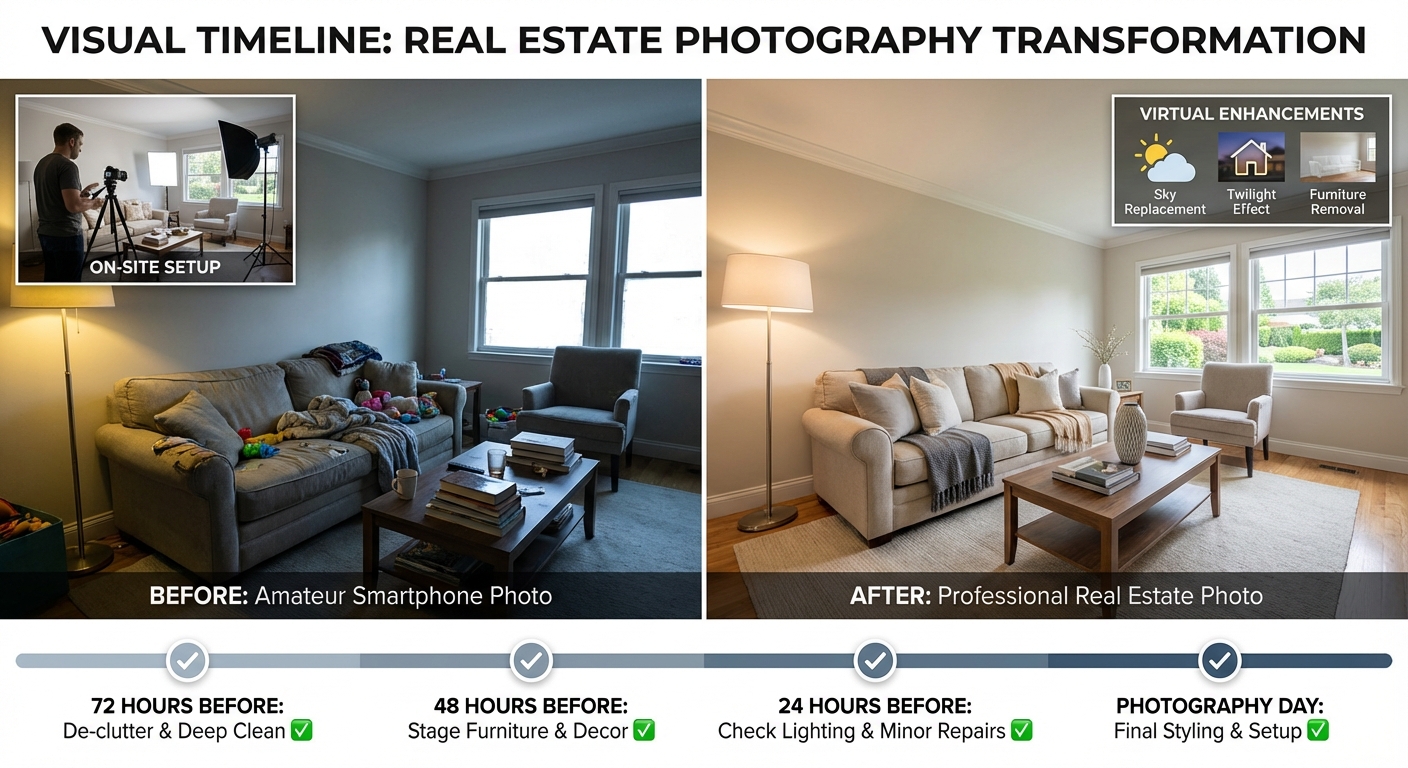
**Photography day preparation checklist**:
72 hours before:
- Schedule for optimal lighting (usually 10am-2pm for interiors)
- Verify all light bulbs work and match color temperature
- Touch up any scuffs or marks on walls
Day before:
- Deep clean again (photographer captures every speck of dust)
- Remove all personal photos, toiletries, and clutter
- Style surfaces with strategic accessories
- Ensure yard is pristine
Photography day:
- Turn on all lights in every room
- Open all curtains/blinds for maximum natural light
- Set dining table with simple place settings
- Add fresh flowers to key rooms
- Make beds with hotel-crisp corners
- Run dishwasher, close shower curtains, hide trash cans
#### Virtual enhancements that work:
Modern listing photos often include digital enhancements that significantly improve appeal:
- **Sky replacement**: Gray overcast days become brilliant blue sky photos
- **Twilight conversions**: Daytime exterior shots transformed to golden hour or dusk images
- **Grass enhancement**: Patchy brown lawns become lush and green
- **Furniture removal**: Show space potential when removing old furniture isn't feasible
These techniques aren't deceptive—they're showing the property's true potential under ideal conditions.
## Common Mistakes That Cost Sellers Thousands
Avoid these frequent errors when selling inherited property:
### Emotional decision-making
Attachment to inherited items clouds judgment. That vintage wallpaper grandmother loved? It's reducing your sale price by $5,000-$10,000. Make decisions based on market data, not sentiment.
### Overimproving for the neighborhood
Installing $40,000 in luxury upgrades in a $250,000 neighborhood rarely returns value. Match your improvements to comparable sales in your specific area.
### Skipping pre-listing repairs
Every issue found during buyer inspection becomes a negotiating point. Fix problems proactively to maintain asking price leverage.
### Poor timing decisions
Real estate is seasonal. In most markets, spring (March-May) brings 15-20% more buyers and higher sale prices than winter months. If your property won't be ready until December, consider waiting until February to list.
### Choosing the wrong agent
Not all agents handle inherited properties well. Find specialists with:
- Experience with estate sales and inherited properties
- Knowledge of necessary legal processes
- Understanding of renovation ROI
- Strong local market expertise
- Proven photography and marketing strategies
### Pricing incorrectly
Overpricing means your property becomes stale on market, ultimately selling for less than if priced correctly initially. Under-pricing leaves money on the table. Use your CMA data and agent expertise to price strategically.
## Timeline and Budget Planning
Create a realistic roadmap before starting improvements.
### Typical timeline for inherited property preparation:
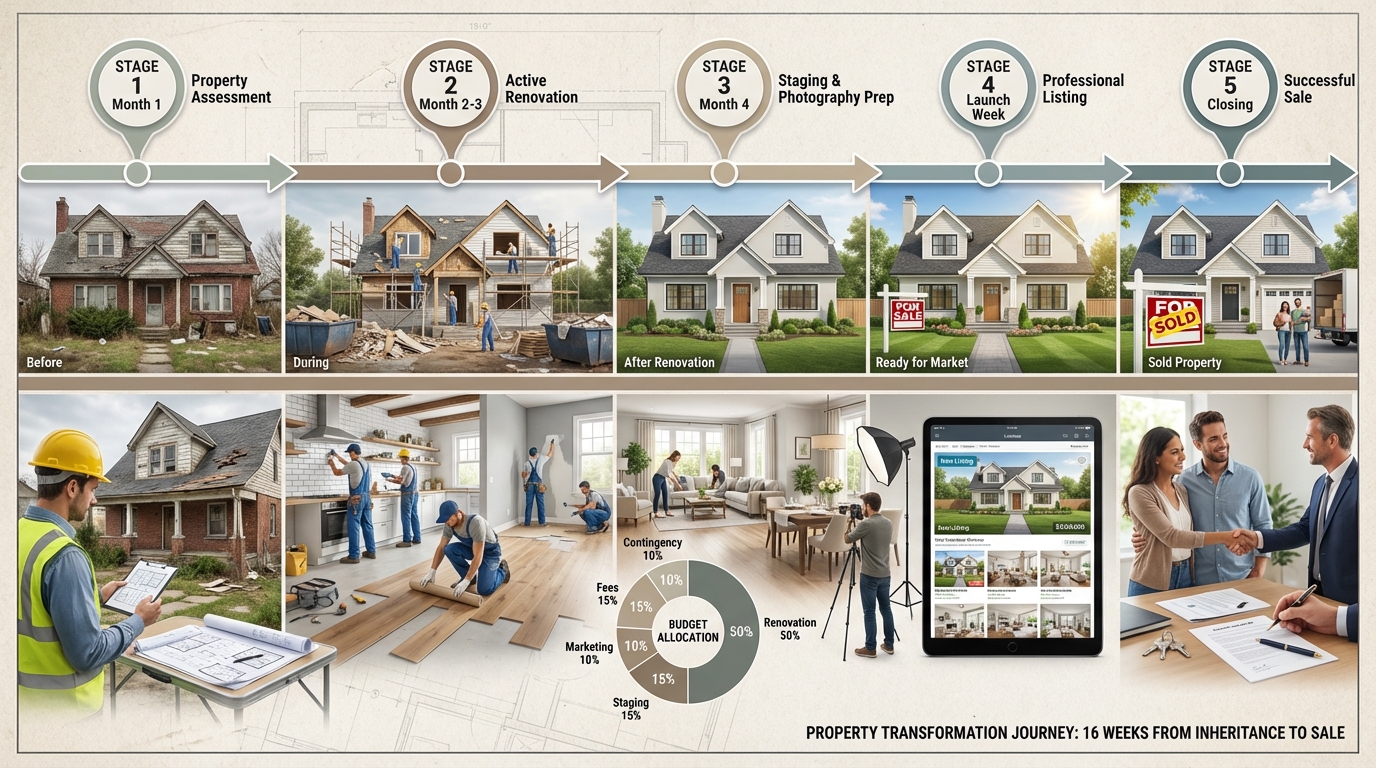
**Month 1: Assessment phase**
- Week 1-2: Secure property, change locks, assess condition
- Week 3: Professional inspection and appraisal
- Week 4: Get contractor quotes, create improvement budget
**Month 2-3: Improvement phase**
- Week 5-8: Major repairs (roof, HVAC, structural)
- Week 9-10: Kitchen and bathroom updates
- Week 11: Exterior improvements and landscaping
- Week 12: Paint and flooring
**Month 4: Preparation and listing**
- Week 13-14: Deep clean and declutter
- Week 15: Staging and styling
- Week 16: Professional photography and listing launch
**Budget allocation guide for $25,000 improvement budget**:
- Repairs and major systems: $10,000 (40%)
- Kitchen and bathrooms: $6,000 (24%)
- Paint and flooring: $4,000 (16%)
- Curb appeal: $2,000 (8%)
- Staging and photography: $1,500 (6%)
- Deep cleaning and miscellaneous: $1,500 (6%)
Adjust percentages based on your specific property condition and local market expectations.
## Measuring Your Success
Track these metrics to evaluate your preparation strategy effectiveness:
**Online engagement**:
- View count on listing within first week (strong: 300+)
- Save/favorite rate (strong: 15%+ of viewers)
- Days on market (strong: under 30 days)
**Buyer response**:
- Showing requests within 48 hours (strong: 5+)
- Offer timeline (strong: multiple offers within 14 days)
- Final sale price vs. asking price (strong: 98-103%)
**Financial return**:
- Total improvement investment: $______
- Sale price above as-is appraisal: $______
- Net gain after improvements: $______
- ROI percentage: ______%
Properties that follow this seven-step approach typically achieve 15-25% higher sale prices than comparable inherited homes sold with minimal preparation, while also selling 30-45% faster.
Professional photography investment of $200-500 dramatically increases online engagement and showing requests
## Making the Final Decision: Sell, Rent, or Keep?
Before implementing these improvements, consider all options for inherited property:
### When to sell immediately:
- You need liquidity for estate taxes or debt settlement
- Property requires extensive repairs beyond your budget
- Location doesn't fit your investment strategy
- Emotional attachment makes ownership painful
- Market conditions are exceptionally favorable
### When to consider renting:
- Strong rental market with positive cash flow potential
- Property is in good condition or you've completed improvements
- You want to defer capital gains taxes
- Local market is temporarily depressed
- Property has long-term appreciation potential
**Rental calculation**: Monthly rent should exceed your carrying costs (mortgage, taxes, insurance, maintenance) by at least 25% to justify rental strategy.
### When to keep long-term:
- Property is paid off and generates strong rental income
- Significant sentimental value and you have use for it
- Location in high-growth area with strong appreciation potential
- Part of diversified investment portfolio strategy
For most inheritors without real estate investment experience, selling after strategic improvements offers the best risk-adjusted return.
## Working With Professionals: Building Your Team
Successfully maximizing inherited property value requires coordinating multiple specialists:
### Essential team members:
**Estate attorney** ($200-$400/hour):
- Handles probate process
- Ensures legal transfer of property
- Advises on tax implications
**Real estate agent specializing in inherited properties** (5-6% commission):
- Provides accurate market analysis
- Manages improvement ROI decisions
- Coordinates contractors and staging
- Markets property effectively
- Negotiates offers skillfully
**Home inspector** ($400-$600):
- Identifies all property issues
- Prioritizes repair needs
- Provides cost estimates
**General contractor** (varies by project):
- Manages improvement projects
- Coordinates subcontractors
- Ensures quality workmanship
- Handles permits and inspections
**Tax advisor/CPA** ($150-$300/hour):
- Calculates capital gains implications
- Advises on timing strategies
- Identifies tax-saving opportunities
- Handles estate tax matters
**Professional photographer** ($200-$500):
- Captures property at its best
- Creates marketing materials
- Provides virtual tour options
**Total professional services cost**: Budget $5,000-$15,000 beyond improvement expenses for professional guidance that protects your investment and maximizes returns.
## Tax Considerations When Selling Inherited Property
Understanding tax implications prevents costly surprises.
### Step-up in basis benefit:
The most valuable tax advantage for inherited property is the "step-up in basis." Your cost basis becomes the property's fair market value on the date of inheritance, not the original purchase price.
**Example**:
- Original purchase price (1985): $75,000
- Value at inheritance (2026): $400,000
- Your cost basis: $400,000 (not $75,000)
- Sale price after improvements (2026): $425,000
- Taxable capital gain: $25,000 (not $350,000)
This step-up in basis can save inheritors $50,000-$100,000+ in capital gains taxes.
### Capital gains tax rates (2026):
**Short-term** (if sold within one year of inheritance):
- Taxed as ordinary income (10-37% depending on tax bracket)
**Long-term** (if held more than one year):
- 0% for single filers with income under $47,500
- 15% for single filers with income $47,500-$523,050
- 20% for single filers with income over $523,050
### Improvement cost deductions:
Money spent on repairs and improvements before sale increases your cost basis, reducing taxable capital gain:
- Cost basis at inheritance: $400,000
- Plus improvements: $25,000
- New cost basis: $425,000
- Sale price: $450,000
- Taxable capital gain: $25,000 (instead of $50,000)
**Document everything**: Keep receipts, invoices, and proof of payment for all improvements to maximize this tax benefit.
### Primary residence exclusion:
If you move into the inherited property and live there as your primary residence for 2 of the 5 years before selling, you can exclude up to $250,000 (single) or $500,000 (married) of capital gains from taxation—a massive potential tax savings.
## Your Action Plan: Getting Started This Week
Transform this information into action with these immediate next steps:
**This week**:
1. Schedule professional home inspection
2. Contact three real estate agents specializing in inherited properties
3. Research comparable sales in your area
4. Document current property condition with photos
5. Create preliminary budget for improvements
**Next week**:
1. Review inspection report and prioritize repairs
2. Get contractor quotes for major items
3. Select real estate agent
4. Finalize improvement budget and timeline
5. Begin decluttering process
**Following month**:
1. Execute high-priority repairs
2. Begin cosmetic improvements
3. Deep clean entire property
4. Plan staging strategy
5. Schedule professional photography
**Final preparation**:
1. Complete all improvements
2. Stage property
3. Professional photos and virtual tour
4. Launch listing
5. Review and respond to offers
Remember: The inherited property market is competitive, but systematic preparation gives you decisive advantages. Properties that follow strategic improvement plans consistently outperform rushed sales by 15-25% in final sale price while spending far less time on market.
Your inherited property represents significant wealth—treat its sale with the strategic attention it deserves, and you'll maximize returns while minimizing stress throughout the process.
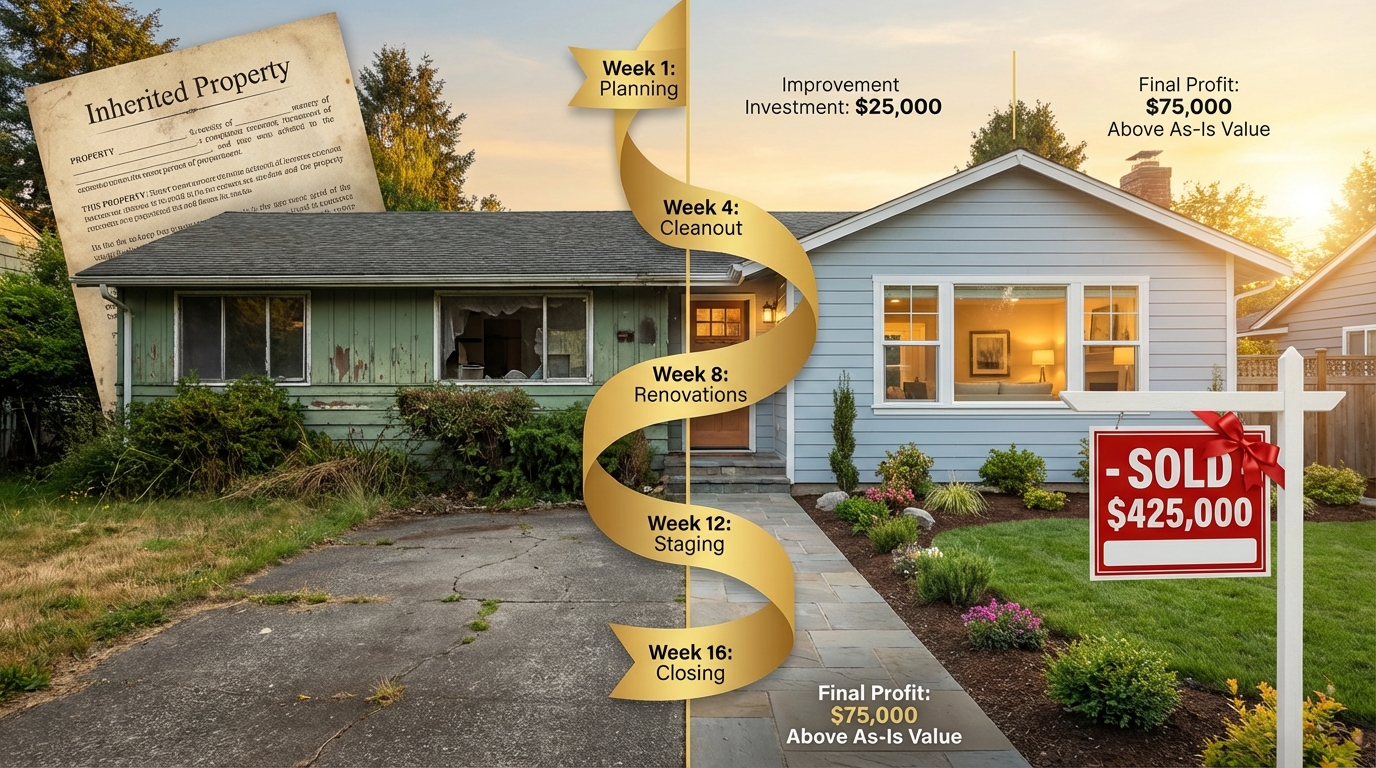
Following a systematic 4-month preparation timeline maximizes property value and reduces time on market by 30-45%
Strategic improvements averaging $25,000 typically generate $50,000-$75,000 in additional sale value for inherited properties
## Conclusion: Your Path to Maximum Value
Inheriting a house presents both opportunity and responsibility. The difference between a hasty sale and a strategic approach can mean $60,000-$100,000 or more in your pocket—money that honors the legacy you've inherited while securing your financial future.
The seven steps outlined in this guide provide a proven framework used by successful real estate investors and professional flippers. By systematically assessing your property, making strategic improvements, presenting it professionally, and timing your sale correctly, you position yourself for maximum returns.
Remember these key principles:
1. **Assessment before action**: Spend the first 30 days understanding what you have before making decisions
2. **Strategic investment**: Focus improvement dollars on high-ROI projects that eliminate buyer objections
3. **Professional presentation**: Photography and staging aren't luxuries—they're essential tools that directly impact sale price
4. **Market timing matters**: Spring listings consistently outperform winter sales by 15-20%
5. **Expert guidance pays**: The right team of professionals protects your investment and maximizes returns
Your inherited property represents years of someone's hard work and financial commitment. By taking the time to maximize its value, you honor that legacy while securing the best possible outcome for yourself and your family.
The four-month preparation timeline may seem lengthy when you're eager to close this chapter, but properties that follow this systematic approach consistently sell faster and for significantly more than rushed sales. The investment of time and strategic improvement dollars pays substantial dividends.
Start with your inspection this week. Every day you delay is another day of carrying costs without progress toward your goal. But equally important: don't rush the process. Systematic preparation, strategic improvements, and professional presentation create the conditions for premium pricing and competitive offers.
Your inherited house can be transformed from an overwhelming responsibility into a significant financial asset. Follow these seven steps, work with qualified professionals, and make decisions based on market data rather than emotion. The result will be a sale price that reflects your property's true potential and your strategic preparation efforts.
Following the seven-step strategic approach transforms inherited properties into maximum-value assets