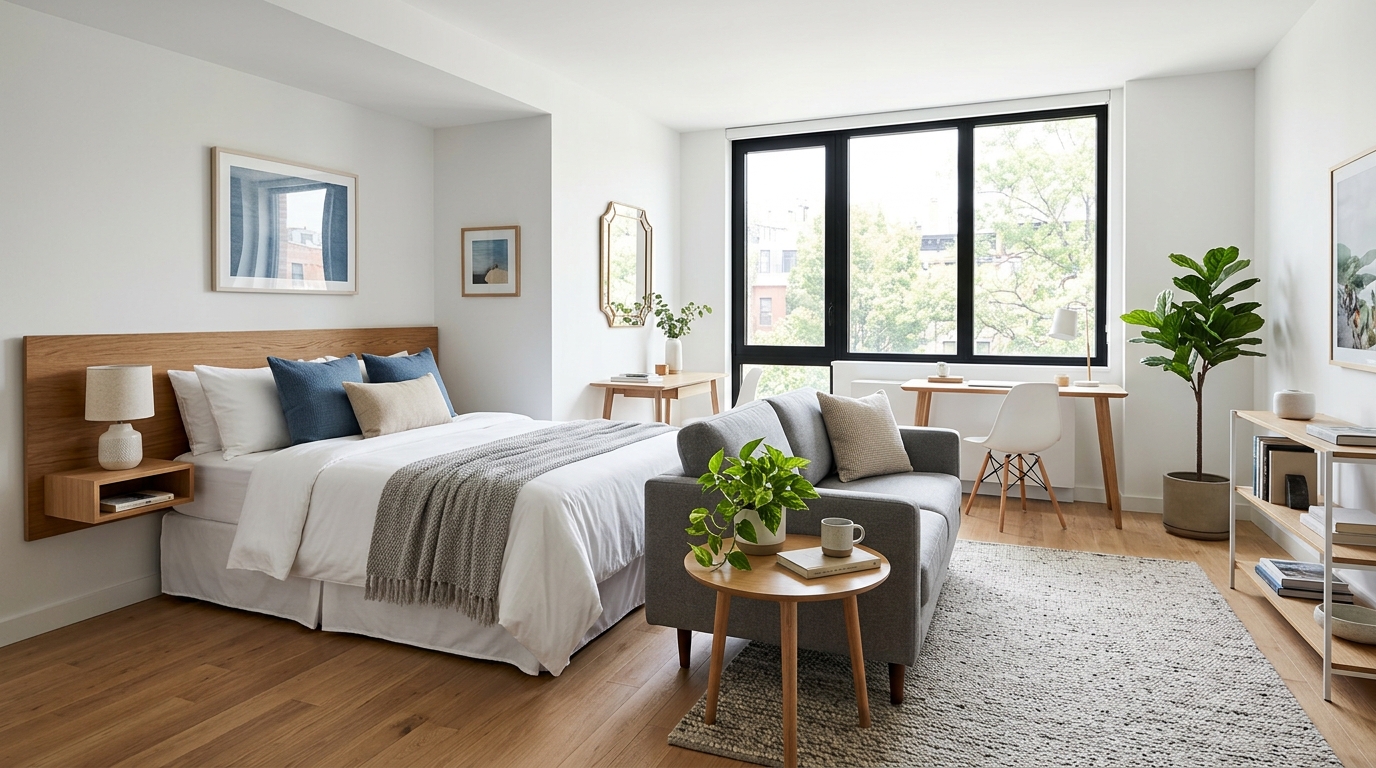
Studio apartment staging ideas are among the most searched topics in real estate marketing — and for good reason. Compact, open-plan units present a unique challenge: how do you help buyers envision a fully functional home in a single room? The answer lies in strategic layout, smart furniture selection, and the power of visual storytelling. Whether you're a real estate agent, property manager, or photographer, these nine space-saving layouts will help you stage studio apartments that sell faster and command stronger offers.
Before you move a single piece of furniture, use PropStage.ai's Buyer Persona Staging tool to identify the ideal buyer profile for your studio — young professional, student, or urban couple — and tailor your staging style accordingly.
Why Studio Apartment Staging Requires a Different Approach
Traditional staging advice doesn't always translate to studios. In a multi-room home, each space has a defined purpose. In a studio, you're asking one room to serve as bedroom, living room, dining room, and often a home office — simultaneously. Buyers struggle to visualize how all of these functions can coexist without feeling claustrophobic. Your staging job is to remove that doubt entirely. A well-staged studio doesn't just look clean; it tells a complete lifestyle story within 400 to 600 square feet.
1. The Zone-and-Rug Layout: Define Spaces Without Walls
The most powerful tool in any studio stager's toolkit is the area rug. By placing distinct rugs under the living area furniture and separately under the bed or dining table, you create invisible walls that signal to buyers: 'This is the lounge. That is the bedroom.' Use rugs with contrasting but complementary patterns or textures. This layout works especially well in rectangular studios where zones can be lined up along the length of the unit. Pair each rug zone with its own pendant light or floor lamp to reinforce the separation.
2. The Murphy Bed Layout: Reclaim the Living Room by Day
A murphy bed — also called a wall bed — is the ultimate space-saving staging prop for studios. When staged in the closed position, the unit photographs as a spacious living room or home office. When shown open during an in-person tour, it reveals a fully functional sleeping area. Pair a murphy bed with built-in shelving on either side to maximize vertical storage and make the wall unit feel intentional and custom rather than improvised. This layout is particularly effective for attracting young professional buyers who prioritize entertaining space.
3. The Floating Furniture Layout: Stop Pushing Everything to the Walls
One of the most common studio staging mistakes is pushing all furniture against the walls in an attempt to create more floor space. Counterintuitively, this makes a studio feel smaller and more institutional. Instead, float your sofa and chairs slightly away from the walls, angled toward a focal point such as a TV console, fireplace, or large window. This creates depth and dimension in your listing photos and gives buyers the sense that the space is large enough to have breathing room between furniture and walls.
Struggling to visualize how floated furniture will look in the listing photos? Use PropStage.ai's Object Placement Tool to digitally place and rearrange furniture in your room photos before any physical staging begins.
4. The Sleeping Nook Layout: Create a Bedroom Without a Door
Some studios have an alcove, a recessed wall, or a partial partition that can be transformed into a dedicated sleeping nook. Stage this area with a platform bed, soft bedside lighting, and a canopy or curtain rod with sheer drapes that can be drawn for privacy. Even if the studio doesn't have a natural alcove, you can create one using a low bookshelf as a room divider or a ceiling-mounted curtain track. This layout gives buyers the psychological comfort of a 'separate' bedroom without requiring actual walls.
5. The Vertical Storage Layout: Sell the Ceiling, Not Just the Floor
In small-space staging, vertical real estate is your greatest untapped asset. Floor-to-ceiling bookshelves, tall wardrobes, and wall-mounted cabinets draw the eye upward and create the illusion of height. Hang curtains as close to the ceiling as possible — even if the window sits lower — to elongate the walls visually. In the kitchen area, stage open shelving with neatly arranged dishware and cookbooks. This layout signals to buyers that the unit has abundant storage, one of the top concerns for studio apartment shoppers.
6. The Mirror-and-Light Layout: Double Your Perceived Square Footage
A large mirror placed opposite a window is one of the oldest tricks in the interior design playbook — and it works just as well in real estate photography. For studio staging, consider a full-length leaning mirror, a mirrored wardrobe door, or a gallery wall of smaller mirrors arranged in a geometric pattern. Combine mirror placement with layered lighting: natural light from windows, ambient overhead lighting, and accent lamps. Bright, evenly lit studios photograph dramatically better and feel significantly larger to in-person buyers.
7. The Multi-Functional Furniture Layout: Every Piece Earns Its Place
In a studio, every staged furniture piece should serve at least two purposes. A storage ottoman doubles as a coffee table and extra seating. A console table behind the sofa becomes a home office desk. A bench at the foot of the bed provides seating and storage. When staging for photography, select furniture with clean lines and legs (rather than skirted or boxy pieces) so the floor remains visible, making the space feel more open. Avoid staging more than one large statement piece per zone — let each functional area have one hero item and keep supporting pieces minimal.
8. The Home Office Integration Layout: Stage for Today's Remote Buyers
Remote work has permanently changed what studio apartment buyers are looking for. A dedicated workspace — even a compact one — is now a major selling point. Stage a small desk, an ergonomic chair, and a task lamp in a corner or against a window wall. Use a floating wall-mounted desk if floor space is extremely limited. Frame this area with a small plant and a piece of wall art to make it feel intentional and aspirational. Buyers should be able to look at your listing photos and immediately think: 'I could work from home here.'
Want to show buyers exactly how a home office corner could look in your studio listing? PropStage.ai's Home Office Setup tool lets you virtually design and visualize a professional workspace in any room photo in seconds.
9. The Neutral Palette Layout: Let the Space Be the Star
Color choice is one of the most impactful — and most overlooked — studio apartment staging decisions. Bold accent walls or dark furniture can make a small space feel cave-like in listing photos. Instead, stage with a neutral base palette of warm whites, soft greiges, and light natural wood tones. Add personality through textiles — throw pillows, a textured blanket, a patterned rug — that can be easily swapped between showings. A neutral palette also photographs exceptionally well, ensuring your listing images look bright and spacious across all screen sizes and platforms.
How AI Virtual Staging Elevates Every Layout
Physical staging a studio apartment is time-consuming and expensive, especially when you're managing multiple listings. AI-powered virtual staging has transformed how real estate professionals approach compact spaces. With PropStage.ai, you can test multiple layout configurations, furniture styles, and color schemes from a single set of property photos — all within seconds. This is particularly valuable for studios, where small changes in furniture placement can dramatically alter how spacious and functional a unit appears to prospective buyers.
For listings with cluttered or dated interiors, start with PropStage.ai's Listing Photo Declutter & Clean tool to digitally remove personal items, excess furniture, and visual noise before applying any staging overlay. This gives you a clean canvas to work with and ensures your staged images look polished and professional.
Quick-Reference: Studio Staging Layout Comparison
| Layout Type | Best For | Key Prop | Buyer Appeal |
|---|---|---|---|
| Zone-and-Rug | Open rectangular studios | Area rugs | Defined living areas |
| Murphy Bed | Studios under 450 sq ft | Wall bed unit | Maximized daytime space |
| Floating Furniture | Any studio layout | Sofa placement | Depth and dimension |
| Sleeping Nook | Studios with alcoves | Curtain track | Privacy and separation |
| Vertical Storage | Low-ceiling studios | Tall bookshelves | Storage confidence |
| Mirror-and-Light | Dark or north-facing units | Large floor mirror | Bright, airy feel |
| Multi-Functional | Minimalist buyers | Storage ottoman | Smart use of space |
| Home Office Integration | Remote worker buyers | Floating desk | Work-from-home ready |
| Neutral Palette | Photography-first listings | Soft textiles | Broad buyer appeal |
Final Thoughts: Small Space, Big Opportunity
Studio apartments represent one of the most competitive segments of the real estate market, and the agents and property managers who win listings in this space are those who master the art of visual storytelling. By applying these nine studio apartment staging ideas — from zone-defining rugs to AI-powered virtual staging — you can transform even the smallest unit into a compelling, buyer-ready home that stands out in online search results and drives faster, stronger offers. The space may be compact, but the opportunity to impress is anything but small.